Anthropic Is Teaching AI Agents to Speak Lab Machine
By Toolbox Ninja · · 5 min read
Anthropic's Model Hardware Standard gives AI agents a shared way to control lab equipment. That solves integration, not judgment or physical safety.
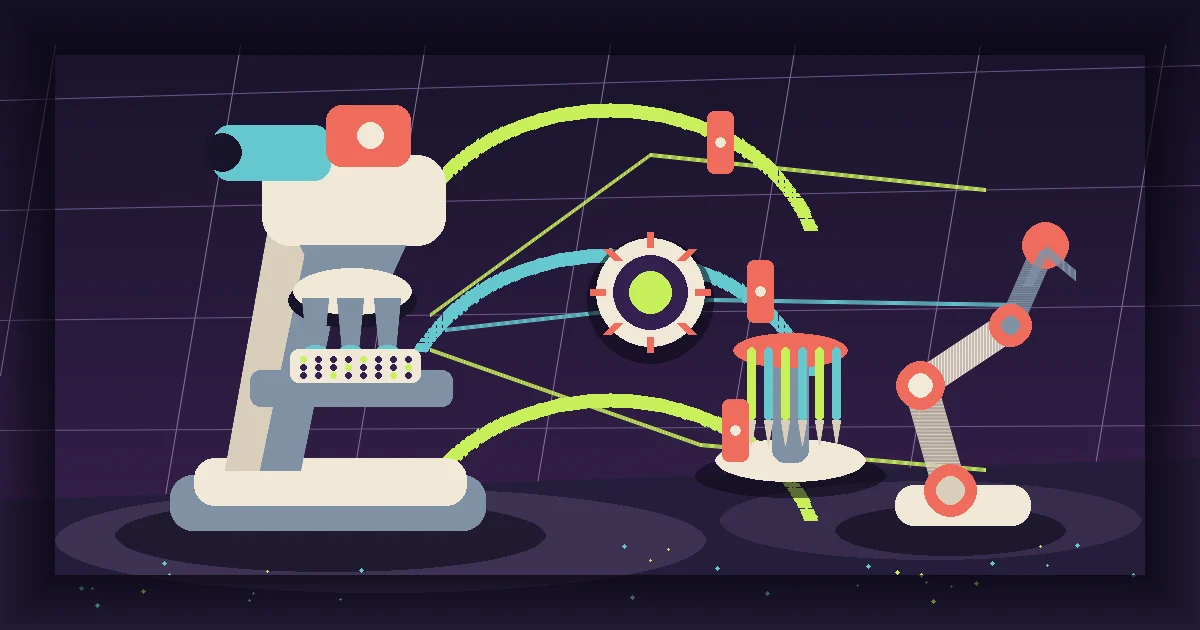
A microscope camera, a robotic arm and a liquid handler can each have perfectly good software and still be miserable to use together. Their interfaces differ. Their control programs may use different languages. A researcher who wants one experiment to coordinate all three can spend weeks writing custom glue code.
Anthropic's new Model Hardware Standard, or MHS, is an attempt to replace some of that glue with a common interface. The company opened a research preview on August 27 for selected scientific labs and manufacturers, after developing the specification with HHMI's Janelia Research Campus.[1][2]
Reuters and Ars Technica both covered the launch within hours, a useful sign that this was drawing attention beyond Anthropic's own newsroom.[3][4]
The pitch sounds a bit like USB for scientific equipment: give very different devices a shared way to describe what they do, expose controls and report their state. The interesting part is not that Claude can move a robot. It is that a model may no longer need a one-off software integration every time it meets a new machine.
What MHS actually standardizes
MHS puts a standardized software driver between an agent and a physical device. The driver reduces hardware operations to simple primitives such as read and write, while publishing a machine-readable description of the device's capabilities, adjustable settings and enforced limits.[1]
That description can include facts that an ordinary API does not capture. A robot arm's weight, for example, matters when software must decide how to manipulate it safely. MHS lets operators add this context in natural language, then produces a reference file the agent can use when planning a task.[1]
Once a device has a driver, an agent can reach it through the Model Context Protocol, a command-line interface or code. Anthropic says MHS is model-agnostic and should work with any device that has a programmable interface, although the preview is currently limited and the company has not yet released it as open source.[1]
That distinction matters. This is an early specification, not a universal connector already built into every microscope and factory robot. Hardware vendors still need to write or adopt drivers. Labs still need to describe their machines accurately. Existing safety systems do not disappear because a language model has a cleaner API.
Why labs care about the boring integration work
The origin story is unusually concrete. Janelia postdoc Arco Bast was trying to coordinate the lasers, mirrors and cameras in a custom microscope. Those parts relied on separate control systems and programming languages, turning a research question into months of engineering work. His shared-memory approach cut the setup from months to days, according to HHMI, and became the starting point for MHS.[2]
That is the problem worth watching. AI demos often focus on the moment a model gives a clever answer. In a lab, the expensive delay may happen earlier: getting the camera to report what it sees, telling the stage where to move and making sure the laser responds at the right time. A standard interface does not make the experiment scientifically sound, but it can make the equipment less stubborn.
Anthropic reports several early tests. Genentech connected a liquid handler, robotic arm and plate reader for a protein assay. University of Washington researchers used MHS for instrument monitoring, a supervised qPCR workflow and collision-free handoffs between a robot arm and liquid handler. Other trials involved microscope control and laser calibration.[1]
These examples are proofs of concept supplied by Anthropic and its partners, not independent evidence that MHS is ready for broad deployment. They do show why a shared hardware layer could be useful: one agent can observe several instruments, sequence their actions and keep a common record of what happened.
The model can still misunderstand the room
A cleaner connection to hardware also gives mistakes somewhere physical to land.
Anthropic's Genentech account includes a useful failure. During liquid handling, Claude encountered bubbles and initially retried the operation in the same well with different parameters. That made the problem worse. A human had to explain the physics, including the need to move to a clean well and mix more gently. The lesson was then saved as a reusable skill for later runs.[1]
This is a better picture of physical AI than the usual robot demo. The agent can recover from some error codes and tune a procedure, yet fail to infer a basic cause that an experienced lab worker recognizes. Software permissions can stop a command that exceeds a declared limit. They cannot guarantee that the declared limit is correct, that a sensor is calibrated or that the model understands why foam has appeared.
MHS therefore separates two problems that are easy to muddle. Interoperability asks whether an agent can communicate with the machine. Competence asks whether it should issue a particular command. A shared driver may help with the first. It does not settle the second.
For anyone evaluating an MHS-style setup, the practical questions are plain:
- Which actions can the agent perform without approval?
- Where are limits enforced: in the prompt, the driver or the device itself?
- Can an operator stop a run when the model or network becomes unresponsive?
- Does the system retain commands, readings, model outputs and human overrides for review?
- What happens when the hardware description is incomplete or wrong?
Those questions are less cinematic than a robotic arm working overnight. They are also the difference between a useful automation layer and an expensive way to create unrepeatable experiments.
A standard has to outgrow its creator
Anthropic says it plans to develop safety evaluations and operating practices with preview partners before releasing MHS as open source.[1] That sequence is sensible, but adoption will depend on details that are not public yet: licensing, governance, driver quality, version compatibility and whether rival model providers and equipment makers participate.
The comparison with USB only goes so far. USB succeeded because many companies implemented a stable technical standard across a huge device market. MHS currently comes from one AI company and a small group of research partners. If it remains mainly a convenient route from Claude to selected lab gear, it will be an integration product. If independent vendors can implement it, test it and shape its rules, it could become infrastructure.
For now, MHS is worth paying attention to because it targets a real bottleneck rather than pretending a smarter chatbot fixes the entire laboratory. Making machines easier for agents to address may save researchers a lot of tedious engineering. It will also make careful permissions, physical safeguards and human judgment more important, because the software will be closer to switches that do something in the world.
Sources
[1] https://www.anthropic.com/news/model-hardware-standard-research-preview — Previewing the Model Hardware Standard [2] https://www.hhmi.org/news/how-one-postdocs-problem-solving-changing-way-scientists-work — How One Postdoc’s Problem Solving is Changing the Way Scientists Work [3] https://www.reuters.com/technology/artificial-intelligence/anthropic-unveils-new-framework-allowing-ai-agents-operate-physical-devices-2026-08-27 — Anthropic unveils new framework allowing AI agents to operate physical devices [4] https://arstechnica.com/ai/2026/08/anthropics-new-hardware-standard-lets-ai-agents-control-the-physical-world — Anthropic's new hardware standard lets AI agents control the physical world